€92
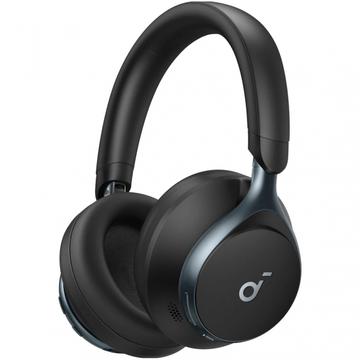
Anker Soundcore Space One Draadloos Zwart
An affordable closed pair with noise cancelling, enough to shut out a room and let the quiet organ swells and the ticking in the score come through.
Over-ear · Wireless · Noise cancelling
Soundtracks · Explainer ·
Hans Zimmer wrote the heart of Interstellar in one night, from a single page about a father leaving his child. The result is a space score built around a church organ: a machine that can only speak while someone feeds it air.
This explainer takes the recorded forces apart one layer at a time, from the Temple Church organ to 60 voices, so you can hear what each adds, and ends with how to listen at home.
Score by Hans Zimmer · Interstellar (2014, dir. Christopher Nolan) · album out 17 November 2014
Zimmer's score for Interstellar started with a sheet of paper. Christopher Nolan did not hand him a script or tell him the film was about space. He gave him one page: a short story about a father who has to leave his child to do an important job, with two lines of dialogue, "I'll come back" and "When?" Nolan asked him to work for a day and then play him what he had. In one night Zimmer wrote a four-minute piece for piano and organ about fatherhood. He called it tiny and fragile. Nolan said it gave the film its heart.
Most space films reach for synthesizers. This one reaches for a church. The signature sound is the 1926 four-manual Harrison & Harrison organ at Temple Church in London, played by the church's music director, Roger Sayer, and recorded there in the spring of 2014. Zimmer has said the instrument's look reminded him of spaceship afterburners, and that its airy sound suggested every breath is precious to an astronaut.
It can only make a sound with air, and it needs breath.
Hans Zimmer, quoted by Empire
That is the whole idea in a sentence. An organ is a machine, but a human one: it only speaks while someone feeds it air. Empire's writer, after hearing the score played live, called it "a deeply human instrument. An organ. Not a synth." The same piece reports Nolan's view that organ and cathedral imagery "represent mankind's attempt to portray the mystical or the metaphysical". So the instrument carries two jobs at once: the physical (breath, limits, a body in a suit) and the spiritual (the far-away and the unknowable).
The finished score is far bigger than the one-night sketch. The recorded ensemble is credited as 34 strings, 24 woodwinds, four pianos and a mixed choir of 60 voices (London Voices), with Zimmer on synth programming and Mario Reinsch on ambient music design. Switch the layers below on and off. The readout tells you what each one is doing in the score, and what is left when you strip the rest away.
Writers on the film have noted that one track, "Mountains", uses a steady ticking that stands for time passing back on Earth, and that the rhythm stretches and collides with silence in a way that echoes the film's time dilation. Treat that as a listener's reading rather than a studio fact: it is how one writer at No Film School hears it, and the idea is not attributed to Zimmer or Nolan there. It is a good way into the track all the same. Listen for what stays regular, and what bends around it.
Zimmer delayed the album until two weeks after the film opened so audiences would meet the score in the cinema first. The "Cornfield Chase" single later went Gold in both the UK and the US. The score was nominated for the Academy Award for Best Original Score and for a Grammy, and in 2022 Zimmer named it the best work of his career. Mark Richards, writing about it, reads the central theme as a love theme between father and daughter, with the action theme doing double duty as the family theme.
The score is on the album, which came out in 2014 on WaterTower, and an expanded edition followed in 2020. Streaming availability of both the album and the film varies by country, so check your own service.
Sources: Wikipedia, Interstellar (soundtrack); Empire, on hearing the score live; Classic FM, Anna Lapwood plays Interstellar; No Film School, on the music and the physics.
Int. the prop room · continuous
Affiliate links, marked sponsored. We may earn a commission at no extra cost to you. Picks that suit the film; products aren't scored. Prices checked 28 Oct; every shop is on each product page.
An affordable closed pair with noise cancelling, enough to shut out a room and let the quiet organ swells and the ticking in the score come through.
Over-ear · Wireless · Noise cancelling
A well-known noise-cancelling pair that suits long listening sessions, good for following the layers of a big orchestral score with the lights off.
Over-ear · Wireless · Noise cancelling
A premium pair for when you want the low organ notes and the quiet gaps between them to count; the one to pick if the score is a regular listen.
Over-ear · Wireless · Noise cancelling